News & Events
Upcoming Events, Fall 2008
2008-09 World Music Ensemble – Open to students
In line with the music and culture emphasis of the department of music and the university’s call for programs aimed at promoting cultural diversity, we will be offering students the opportunity to play in a non-western music ensemble. In 2008/2009, we will be starting a Chinese percussion ensemble utilizing Chinese clappers, Buddhist prayer drums, cymbals, gongs and the Japanese taiko drum. We will explore repertoire, composed specifically for Chinese percussion instruments, which has won China’s national percussion competitions.
Rehearsals will be held weekly on Mondays from 12:50 to 1:40 pm at Room 115 Crowley. Spaces are limited. Interested participants should email Professor Stephanie Ng at sng1@nd.edu as soon as possible to secure a place in the ensemble.
Sweatshirt Sales!!!
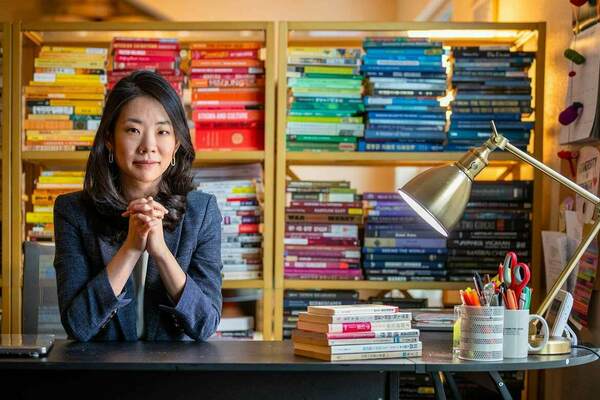
Alumni and Students – take this opportunity to show your spirit and promote the program. For $20 plus shipping ($5.00), you, too, can look as good as model Rachel Donovan, chair of the East Asian Languages and Cultures Student Advisory Committee.
To order: send your name, sweatshirt size, $25 in cash, and mailing address to
Joan Rhoads
Department of East Asian Languages and Cultures
205 O’Shaughnessy
Notre Dame, IN 46556
Past Events:
On Friday, April 18, 2008, the first Chinese Speech Contest was successfully held in DeBartolo Hall.
Thirty-five students participated in the First Annual Chinese Speech contest. They competed in four categories by level: 1st Year Students; 2nd Year Students; Advanced Students (3rd, 4th, and Advanced Chinese classes), and Heritage Speakers. Some of the students used speeches they had written. Others used song lyrics or internet articles.
Students Celebrate the Year of the Pig
Everyone loves a reason to throw a party, and for the Department of East Asian Languages and Cultures (EALC), there’s no better time than the Lunar New Year. In early February, a crowd of over 150 people celebrated the Year of the Pig at the largest Asian New Year Festival on campus.
From 101 DeBartolo to the Chinese Countryside

Notre Dame students have long studied in China through an affiliated program, the Center for International Educational Exchange, in order to improve their command of Mandarin and learn alongside Chinese university students. Yet they still wanted a distinctly Notre Dame experience of the country.
Spring 2008 Film Event
What: Tibetan Film Festival
Why: To learn and discuss the history of the conflict between Tibet and China.
Tibetan Film Festival – April 16-18 (Wednesday-Friday)
Have you seen the recent protests in Tibet against the Chinese government? Interested in learning about it? Want to learn more about the boycotting of the 2008 Beijing Olympics and the protests over the Olympic torch relay? Learn about these hot topics at The University of Notre Dame’s first Tibetan. Film Festival that was held from April 17th-19th, 2008. Three movies were screened followed by discussions led by Notre Dame Professors. These were award-winning and powerful films as you fly to the “rooftop of the world” on the wings of compassion. This was inspirational.
The festival was hosted by the Center for Asian Studies and The Helen Kellogg Institute for International Studies. It is co-sponsored by the Department of East Asian Languages and Cultures as well as the Kroc Institute for Peace Studies.
Films that were shown:
1) Wednesday April 16th, 2008, 8pm at DeBartolo 126
Cry of the Snow Lion (2003) Directed by Tom Peosay
Discussion: Chinese Nationalism and the media.
Mediator: Professor Susan Blum
2) Thursday April 17th, 2008, 8pm at DeBartolo 126
Compassion in Exile: The Story of the 14th Dalai Lama (1993) Directed by Michael Lemle
Discussion: Current Events, 2008 Beijing Olympics and US involvement.
Mediator: Professor Lionel Jensen
3) Friday April 18th, 2008, 8pm at DeBartolo 126
10 Questions for the Dalai Lama (2006) Directed by Rick Ray
Discussion: Conflict and Peace building in Tibet and China
Mediator: Professor Peter Moody
Other Past Events:
Asian Film Festival took place March 27-29 at Browning Cinema,
Debartolo Performing Arts Center, University of Notre Dame.
On the festival schedule click on the drop down menu to film at the center top of the page to see the film information for the event.
Festival Schedule
Event Poster
Event Trailer
2007 News
ND Asian program growing
Excerpt from the ND SMC Observer
Over the past several years, student interest in Asian Studies has grown - prompting the University to expand its academic offerings in the subject. Notre Dame's connection to Asia began nearly 30 years ago, as University President Emeritus Father Theodore Hesburgh traveled there to create a stable interconnection and exchange with academics in China.
Read Full Article
Notre Dame professor’s book examines Taiwanese atrocity
By: Gail Hinchion Mancini
Date: January 22, 2008

In 1947, an anti-government uprising in northern Taiwan led to the slaughter of some 20,000 citizens and contributed to a 40-year period of government suppression that effectively buried knowledge of the incident until martial law ended in 1987.
How the uprising re-entered the public consciousness through literature and film is examined in a new book by Sylvia Lin, assistant professor of East Asian languages and cultures at the University of Notre Dame. Called “Representing Atrocity in Taiwan: The 2/28 Incident and White Terror in Fiction and Film,” it is published by Columbia University Press.
A native of Taiwan, Lin has first-hand experience of living in a totalitarian state, exemplified by the era known as White Terror. During the 40 years of martial law, the government effectively suppressed challenge by arresting and imprisoning dissidents and by instilling a pervasive fear in the citizenry. The bloodiest of these acts occurred around Feb. 28, 1947, a melee that began when government agents harassed a woman who was selling untaxed, black market cigarettes.
Fearing retribution, Lin’s parents’ generation refused to discuss the 2/28 incident even in private. Unlike the Jews in the Holocaust or the Japanese who survived Hiroshima, Lin’s generation grew up unaware of this national tragedy.
The subsequent awakening provides a case study on the lasting cultural impact of atrocities, particularly as they are portrayed in literature and film. Drawing on abundant Holocaust scholarship of atrocity and trauma, Lin analyzes Taiwanese and Chinese literature and post-martial law cinema and identifies emotional and reflective patterns that appear across cultures.
Time is needed to support an environment in which art turns from themes such as anger or victimization to those that honor the sacrifice of the dead and grasp the tragedy of human suffering. However, Lin’s book cautions, the process demands judicious deliberation to avoid a reversal of interpretive tyranny after a regime change.
A member of the Notre Dame faculty since 2002, Lin teaches modern and contemporary Chinese literature, film and culture. Her research interests include Western missionaries and Chinese women, women and new culture in early 20th century China, language and identity in Taiwan, and narrative theory. She earned her doctorate from the University of California, Berkeley.
Passion for Japanese Poetry Leads to NEH Recognition
“Kannon assumes thirty-three forms to mingle in our uncertain world. By our passions does she lead us, and with compassion teach us, using love as a bridge to enlightenment that we may cross and be saved.”
With these words, Chikamatsu Monzaemon, an early modern Japanese playwright, concludes the prelude to The Love Suicides at Sonezaki, the first of his “"contemporary-life plays" for the puppet theatre.
The play tells the tragic tale of Tokubei, who disgraces his family by refusing an arranged marriage. In the final tragic scene, he and his love, Ohatsu, who is a prostitute, escape into the woods and commit suicide.
“The description of their journey to the woods, sung by a chanter in the puppet theatre, begins with one of the most beautiful passages in the Japanese language,” says Michael Brownstein, associate professor of Japanese and a 2007 National Endowment for the Humanities (NEH) fellowship recipient. “This play has become one of the most popular plays in the Kabuki repertoire as well as the Bunraku (puppet) theatre in Japan.”